A prospecting game on Robinhood Chain that pays out in gold. Every round opens a field of 25 claims, one of them holds the strike, and the reserve behind it fills with gold as the token trades.
$GSR pairs with GLDon
GLDon Pons,pays prizes in gold and settles on
 Robinhood Chain
Twenty-five claims.
One strike.
Each round lays a fresh five-by-five survey over new ground. Put your attempts on the plots you like. When the clock runs out, a public commit-and-reveal draw picks the one claim that holds the deposit, and everyone who prospected it splits the round's rewards by attempts.
The shading on each plot is the crowd. A busy claim pays less per attempt if it hits. An empty one pays you the lot.
- Barren
- Nothing in the core sample.
- Trace
- Borders the deposit. Readings, no ore.
- Ore
- The strike. Pays the round's reward pool.
- High-grade ore
- A rich strike. Pays 2.5× the pool.
- Motherlode
- Rare. Pays the pool plus the whole motherlode pot.
2 claims selected: B3, C3
2 in 25: a 8% chance one of them holds the strike. Test field, nothing is staked.
A round, from open to strike.
Rounds run back to back, all day. Each one is self-contained: funded before it opens, drawn in public, settled in the same transaction that picks the strike.
- 1
The field opens
A field is always open. Its clock starts with the first claim, and the reward pool is already funded from trading fees before anyone stakes.
- 2
You stake claims
Spread attempts across as many plots as you like, or stack them on one. You can add more until the clock hits zero.
- 3
The strike is drawn
The operator reveals a secret it committed to before the round opened. The contract mixes it with a fresh block hash, and the result maps to one claim. All of it is published.
- 4
Rewards settle
Everyone on the winning claim splits the pool in proportion to their attempts, sent straight to their wallets. If nobody staked it, the pool rolls into the next round.
- Strike
- C4, high-grade ore
- Reward pool
- 0.84 GLD
- Attempts staked
- 471
- Winning prospectors
- 6
- Paid out
- 2.10 GLD
- Randomness seed
- 0x9f3c42a8…7be0e21a
You never pay to enter.
Nobody deposits ETH or USDG for a chance at a prize, and staking costs no gas: your claims are relayed for you. Rewards come out of trading fees. Attempts are earned by holding $GSR. You keep the tokens; nothing is spent.
Every round leaves a receipt like this one: the pool, the attempts, the randomness seed and the settlement transaction. You can check any of them against the chain yourself.
Fees go in. The reserve goes up.
$GSR trades against GLD, the gold token. Every trade pays a creator fee, and that fee is the protocol's only income. All of it is routed onchain, where anyone can follow it.


GSR / GLD pool
Launched on  Pons
Pons
A creator fee is taken from each trade. It is paid in gold, because gold is what $GSR trades against.
Creator fees
Claimed onchain, every minute
30%
Gold prizes
Fees arrive as GLD. This share is added to the prize pool, and winners are paid in gold.

40%
Gold reserve
Held as GLD in the public reserve vault.
30%
$GSR buyback
Buys $GSR on the open market, held in the public reserve vault.

Automatic routing is paused right now, so fees are accruing in Pons' escrow. This is the split they will follow.
Gold is already onchain.
GLD is Robinhood's token for a share of the SPDR Gold Trust, the largest gold fund there is. It is an ordinary token on Robinhood Chain: it can sit in a contract and be sent to any wallet. So this reserve can hold gold, and the game can pay in it.
What the reserve holds
- Gold prizesA share of every fee, which arrives as GLD, is added to the prize poolAt launch
- Gold in the reserve vaultAnother share is held as GLD in the public vaultAt launch
- $GSR, bought backThe rest buys $GSR on the open market for the vaultAt launch
All three happen onchain, on a schedule, from the same fees. The Reserve page shows the vault's gold and prices it from the live market.
Why gold
- It doesn't tarnish.
- Gold doesn't rust or corrode in air or water, which is why coins centuries old still shine.
- It has a colour.
- Almost every metal is grey. Gold and copper are the two everyday exceptions.
- It is scarce.
- All the gold ever mined would fit in a cube roughly twenty metres on a side.
- It has a public price.
- It trades around the clock, and the London price is fixed twice a day.
None of that makes $CSR worth anything. It is why copper is the metal worth building a reserve around.
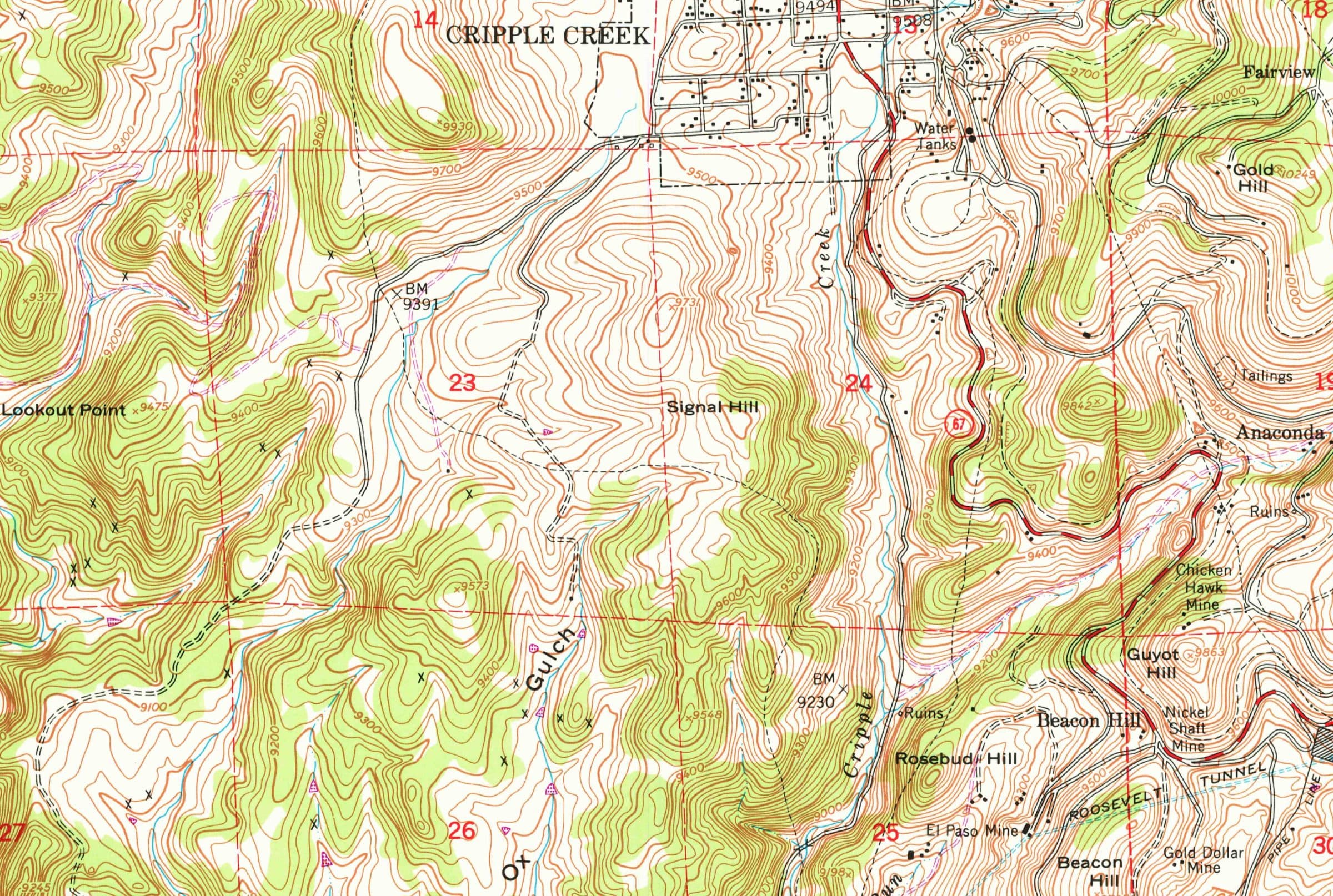
Map: U.S. Geological Survey, Cripple Creek South quadrangle, Colorado, 1951. Gold was found here in the early 1890s, setting off one of the last great gold rushes in the American West. Gold Hill, the Gold Dollar Mine and the Roosevelt Tunnel are all printed on the sheet.
Why pair with gold?
Pons pays a token's creator fees in whatever it is paired with. Pair $GSR with GLD and the fees arrive as gold: nothing has to be converted, and what reaches the prize pool and the reserve vault is exactly what traders paid. GLD has a deep market against USDG on Uniswap, so getting in and out of it is not the hard part.
Fair questions.
The short version: it's free to prospect, the draw is public, and the reserve only claims what it can prove.
Stake your first claim.
Connect a wallet, pick your ground, and see what the survey turns up. It costs nothing to prospect.